

Student Research Club UbiCOMP – project title: “Adaptable office space – enhancing work comfort through mobile, reconfigurable wheeled platforms”.
The strategic objective of the project is to create at least two innovative mobile wheeled platforms equipped with interactive touchscreens, which will become fully modular office workstations of the future.
These intelligent platforms will be able to move around the office space thanks to an advanced differential drive, and also change their height up and down using precise linear actuators, allowing work in a sitting or standing position, as well as during team collaboration.
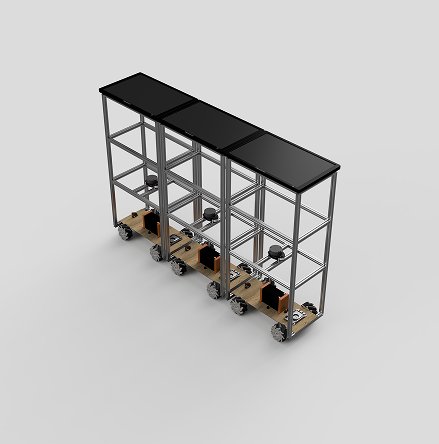
The innovative nature of the solution lies in combining mobility with an interactive touch surface and the possibility of full personalisation of the platform – from height adjustment, through adaptation to the user’s stature, to individual needs of users, including people with reduced mobility. The platforms will be equipped with active motion-tracking markers and inertial sensors, which will make it possible to determine their position precisely in three-dimensional space, while additional user markers will enable automatic adjustment of the workstation’s position and height in real time.
Interaction with the platforms will be completely safe – which is a priority – thanks to distance sensors, emergency stop switches and dedicated collision-avoidance algorithms.
From a scientific perspective, the project aims to develop a set of requirements and guidelines for designing mobile office platforms and to assess their practical usability through empirical studies involving users.
The outcome will be a solution that offers a new way of looking at office space, delivering mobility, interactivity and personalisation in a way that traditional stationary desks with screens cannot achieve. This combination of technology, ergonomics and flexibility creates an entirely new category of intelligent workstations.
The project supervisor is Julia Dominiak, PhD from the Institute of Applied Computer Science at the Faculty of Electrical, Electronic, Computer and Control Engineering. The amount of the grant awarded is PLN 57,300.00.
Student Robotics Research Club – project title: “Multi-domain detection and guidance of UAVs based on information fusion from low-cost sensors”.
The aim of the project is to develop and build a prototype unmanned aerial vehicle (UAV) equipped with an innovative, compact sensor module that integrates data from three different sources: acoustic sensors, an infrared (IR) camera and a visible-light camera. The module, built from low-cost components, will be designed so that it can be mounted both on a mobile UAV platform and in a stationary version.
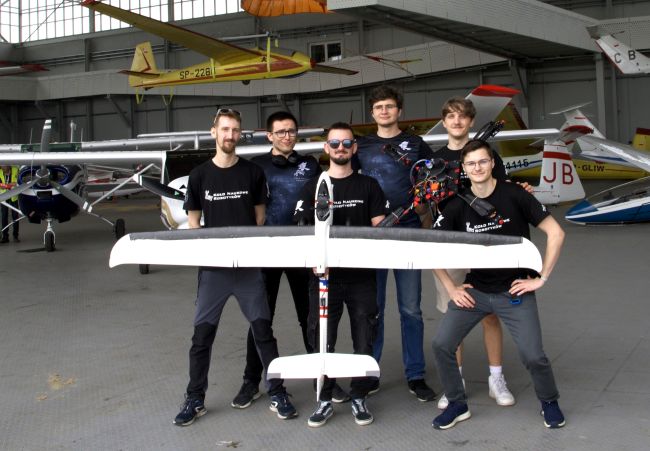
The system will be responsible for detecting, locating and tracking aerial objects by using multi-domain analysis of data from various sensors. Integration of the module with the UAV platform will include not only physical mounting and placement of sensors, but also configuration of the onboard computer and development of software for real-time data processing. The information obtained will be used for automatic modification of the drone’s behaviour, allowing it to react immediately to objects detected in airspace.
The main goal of the project is to carry out a feasibility study of a UAV guidance system for other flying objects using fused data from low-cost sensors. The results will make it possible to assess both the effectiveness and the potential of such a solution in the context of a limited budget and component miniaturisation. The project is research-and-development in nature and covers all stages – from conceptual and design work, through construction, to experimental testing.
The supervisor of the Research Club is Błażej Witkowski, PhD from the Institute of Machine Tools and Production Engineering at the Faculty of Mechanical Engineering. The student team leaders are Jakub Sosnowski, Piotr Rosiak and Patryk Skwierczyński. The total value of the project is PLN 70,000.00.
Student Automotive Enthusiasts Research Club – project title: “Eagle Three: Construction of an innovative, highly efficient next-generation solar vehicle to represent Poland in international solar competitions”.
Eagle Three – a new generation of solar vehicle – is now being developed. The project focuses on radically reducing energy losses and maximising energy conversion efficiency at every stage of the vehicle’s operation. It is not just another step in technology development – it is a bold vision of future mobility in which every fraction of energy works with maximum efficiency.
This means using state-of-the-art technologies, precision engineering and multi-stage validation of solutions in real-world conditions. Every component – from the high-efficiency drive to the aerodynamic body made of structural biocomposites – will be optimised to achieve exceptionally high efficiency.

A key element of the 5-seater Eagle Three will be an innovative, next-generation photovoltaic system. Flexible high-efficiency cells will be integrated into the curved body surface, creating a coherent, aerodynamic platform capable of making maximum use of solar energy. The result? Significantly increased energy yield and a real extension of the vehicle’s range.
Project development will include several prototype iterations and intensive testing in real conditions at the Lodz Race Track. This is where the results of simulations and calculations will be verified – from the efficiency of the drive, motor and tripod (three-arm) joints, through the performance of the photovoltaic cells, to the verification of airflow in the most critical areas. The tests will also confirm the actual energy savings achieved thanks to the proprietary intelligent energy management system.
Eagle Three is more than just a solar vehicle. It is a technology of the future, where innovation, precision and solar energy together can chart a new course for sustainable mobility.
The supervisor of the Research Club is Rafał Dychto, PhD from the Institute of Turbomachinery at the Faculty of Mechanical Engineering. The project leader is Jakub Dobrysiak. The amount of the grant awarded is PLN 69,600.