priority research area: (Re)EnergyTech
Research achievements
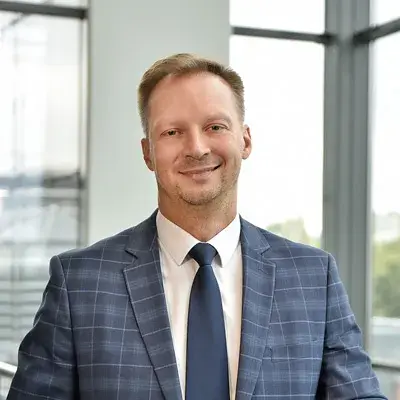
Professor Łukasz Kaczmarek, a professor at the Faculty of Mechanical Engineering at Lodz University of Technology and Chair of the Materials Engineering Discipline, is a specialist in materials engineering, nanotechnology, and advanced functional materials. His research focuses on the design and functionalisation of carbon nanostructures, with a particular emphasis on graphene and graphene quantum dots, for applications in energy and environmental protection.
He is a co-creator of pioneering technologies, including spatial graphene structures for reversible hydrogen storage and methods for synthesising graphene quantum dots from biowaste in accordance with the principles of green chemistry. His activities bridge fundamental research with high-application-potential work, employing experimental methods and molecular modelling to describe phenomena at the atomic level.
Research profile and interests
Professor Kaczmarek’s primary research areas include materials engineering, with a specific focus on nanotechnology and graphene materials. He is involved in the functionalisation of carbon nanostructures, the development of materials for the hydrogen economy, advanced non-silicon photovoltaics, and sustainable energy technologies.
He is currently focusing on the development of technologies for producing graphene quantum dots from biowaste and their utilisation in a new generation of flexible photovoltaic cells, thereby supporting the energy transition and the circular economy.
Industrial cooperation, implementations, and expert activity
Professor Ł. Kaczmarek actively bridges the gap between science and industrial practice, evidenced by his co-founding of the spin-off company Advanced Graphene Products S.A. and his work on HSMG® graphene technology.
He is the author or co-author of numerous patents, including those concerning graphene functionalisation, hydrogen storage, and water purification methods. He also participated in the development of innovative thermo-chemical treatment technologies (FineCarb®, PreNitLPC®), which have been implemented in industrial systems for the Seco/Warwick S.A. group.
The Professor holds several expert roles, serving as, among others, an NCBR expert in programmes supporting high-risk innovation and as a representative in Bridge Alfa-type funds. He is a member of the Committee of Materials Science and Metallurgy of the Polish Academy of Sciences (PAN) and the Polish Materials Science Society.